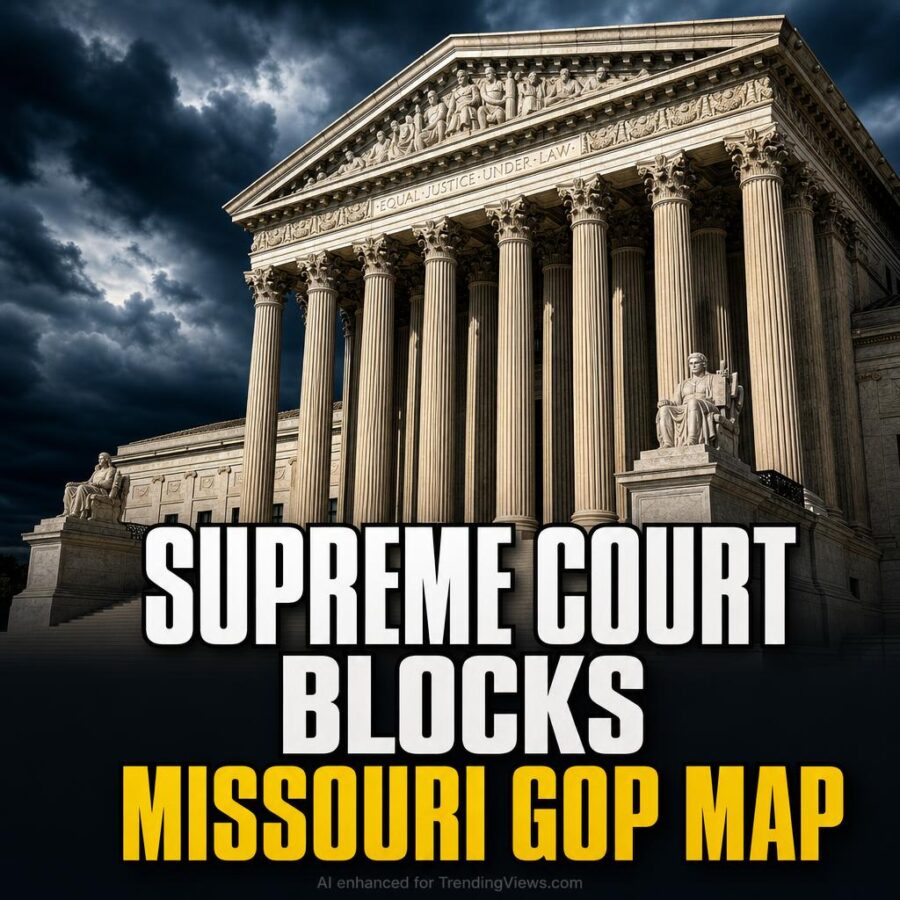
The U.S. Supreme Court has blocked Missouri from using its Republican-drawn congressional map this November.
The court issued the order Thursday with no noted dissents, granting an emergency request from People Not Politicians and activist Richard von Glahn. The ruling halts a lower federal court decision that would have forced Missouri to run its midterm elections under newly redrawn district boundaries.
Missouri’s 2022 congressional map now stays in place for November. That map sends six Republicans and two Democrats to Washington.
Special offer for our readers:
Put Interest On Ice With These Top Credit Cards
The central figure in the dispute is Democratic Rep. Emanuel Cleaver, who represents Missouri’s 5th Congressional District. The 2025 Republican-backed map would have redrawn his Kansas City-area district substantially, potentially handing the GOP seven of Missouri’s eight House seats.
Von Glahn responded sharply to the ruling, saying the Missouri constitution had been clear throughout the fight. He also directed pointed criticism at Missouri Secretary of State Denny Hoskins, who pushed to hold the election under the new lines. Von Glahn said Hoskins “has shown that he cannot effectively do the job he was elected to do.”
As originally reported, Thursday’s Supreme Court action specifically blocked a ruling issued just two days earlier by U.S. District Judge Stephen Clark, who had ordered the state to use the 2025 map despite a conflicting decision from Missouri’s own Supreme Court.
Hoskins’ legal team argued in an urgent appeal to the justices that Clark’s order was the only thing preventing the disenfranchisement of hundreds of thousands of voters who had already cast primary ballots under the new districts. The Trump administration sided with Hoskins, warning that blocking Clark’s ruling would put state officials in an impossible position ahead of the federal election calendar.
It was the second time in days that the Missouri map fight had reached the nation’s highest court. Justice Brett Kavanaugh had rejected Hoskins’ earlier attempt Tuesday to block the Missouri Supreme Court’s order barring the 2025 map from taking effect.
The roots of the dispute go back to a Republican redistricting push launched in 2025, encouraged by President Donald Trump, who urged GOP-controlled states to redraw congressional lines before the 2026 midterms. Missouri Republicans drew a new map that would have made Cleaver’s district significantly harder for Democrats to keep.
Opponents collected more than 300,000 signatures to force a referendum on the new boundaries. Hoskins rejected that effort, arguing that congressional redistricting was not subject to Missouri’s referendum process.
The Missouri Supreme Court disagreed unanimously. In a Sept. 3 ruling, the court found that the state constitution allows voters to weigh in on any act of the general assembly through referendum, with no applicable exception for congressional redistricting. The court ordered Hoskins to certify the referendum for the November ballot and declared that the 2025 map had never legally taken effect.
A federal challenge was filed separately by Republican congressional nominee Rick Brattin, GOP Rep. Bob Onder, and two voters. Clark sided with them, setting up a direct clash between federal and state court rulings.
Missouri’s ballot deadline passed Tuesday. The first absentee ballots are scheduled to go out September 19. Hoskins also faces a contempt hearing before the Missouri Supreme Court over his handling of its earlier order, adding yet another dimension to a fight that has consumed the state’s election machinery for weeks.