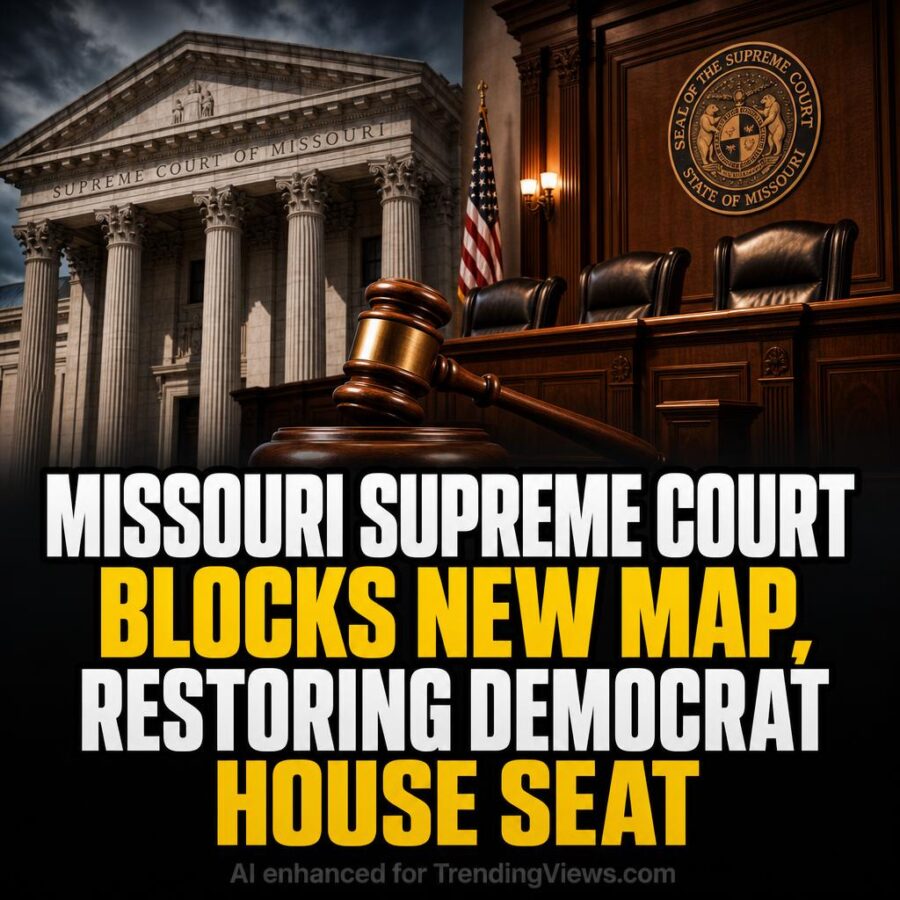
Missouri’s Supreme Court just handed Democrats a congressional seat they were on track to lose.
The court ruled Thursday that a 2025 redistricting law cannot be used in the November 2026 general election unless Missouri voters first approve it by referendum. That decision reinstates the state’s previous congressional map, a 6-2 Republican-Democratic split, and blocks a newer map that would have given Republicans seven of the state’s eight congressional seats.
The ruling came in von Glahn v. Hoskins and reversed a lower-court decision. The court ordered Secretary of State Denny Hoskins to certify a referendum petition for the November 3 ballot. Hoskins had declined to do so on August 4, 2026, arguing that congressional redistricting was not subject to referendum. A Cole County circuit court backed him on August 19. The Supreme Court disagreed, reversing that judgment after hearing arguments on September 2.
Special offer for our readers:
Tackle your credit card debt with 0% intro APR into 2027
The core of the ruling rests on Article III, Section 49 of the Missouri Constitution, which gives the public the power to approve or reject acts of the state legislature by referendum. The court found that congressional redistricting does not qualify for any of the constitutional exceptions, which cover specific appropriations and emergency measures tied to public peace, health, or safety.
As originally reported, the law in question, House Bill 1, was passed during a special legislative session in September 2025 and signed by Gov. Mike Kehoe on September 28, 2025. Under the constitution, a referred measure only takes effect after a majority of voters approve it. Since that approval never happened, HB 1 never legally took effect.
The 2025 map had restructured districts around Kansas City, splitting the city across multiple districts and pushing the 5th Congressional District, held by Democratic Rep. Emanuel Cleaver, into more rural territory. Analysts reviewing 2024 presidential vote data concluded the new lines would have produced seven Republican-leaning seats. The old 2022 map, drawn after the 2020 census, will now govern the November 2026 race.
The court enjoined Hoskins and anyone working with him from implementing the HB 1 districts for that election. HB 1 could still take effect, but only if voters approve it on November 3 and 30 days pass after that vote.
This is not the first time the courts have weighed in on this map. In March 2026, the Supreme Court ruled 4-3 that the constitution does not bar mid-decade redistricting. In May, it unanimously rejected challenges claiming the map violated compactness, contiguity, and equal-population standards under Article III, Section 45.
A group called People Not Politicians gathered more than 305,000 signatures in December 2025 to force the referendum, setting off the legal chain that led to Thursday’s decision.
Election officials now face a logistical challenge. The August primary was run under the new map. The November general election will use the 2022 districts instead, requiring adjustments to precinct assignments, ballots, and voter notifications statewide.