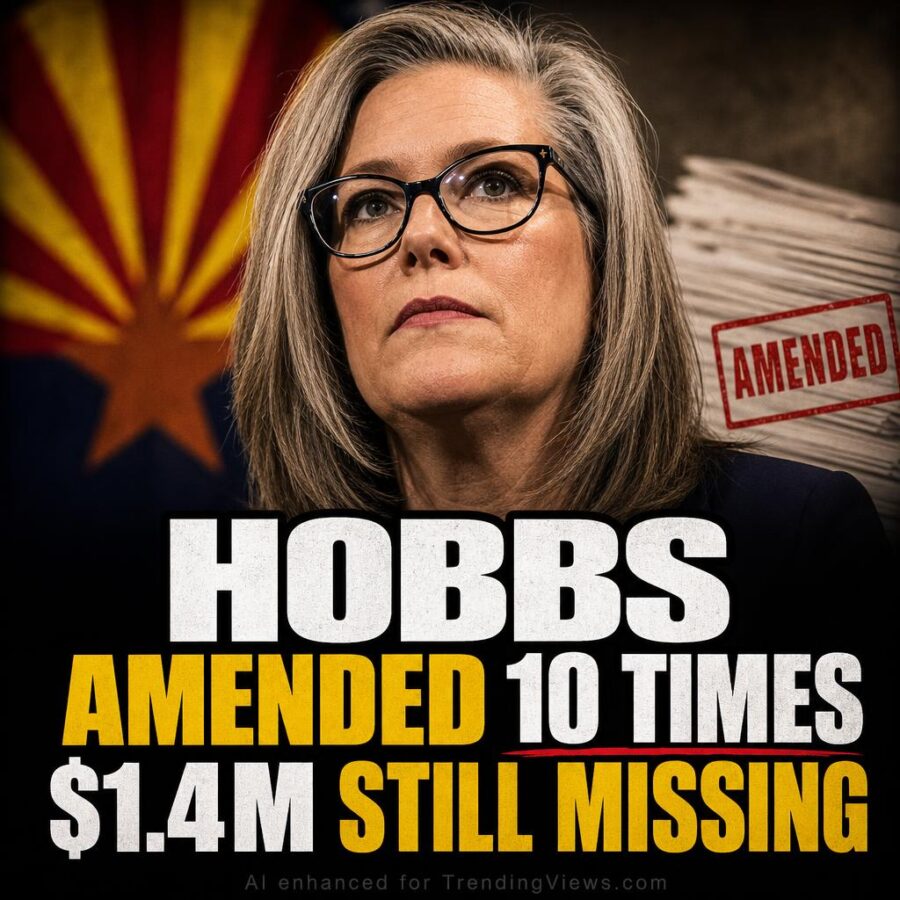
Arizona Gov. Katie Hobbs amended one quarterly finance report ten times, and $1.4 million remains unaccounted for.
This is not a story about a typo. It is not a transposed digit or a single corrected entry. It is a sequence of ten amendments to a single quarterly report, during which more than a million dollars appeared, disappeared, partly came back, and ultimately left a gap that nobody in the Hobbs campaign has explained.
The original filing showed $1,426,552 in exempt small-dollar contributions, meaning donations under $100 reported in aggregate, for the second quarter of 2026. The first amendment kept that figure intact. Then it fell to zero. It stayed at zero through at least one more revision. The fourth amendment brought back $394,785. After six additional changes, the campaign settled on $394,802. The math is straightforward: more than a million dollars in reported contributions simply stopped appearing on the books.
Special offer for our readers:
Put Interest On Ice into 2027
As originally reported by the Daily Caller, the instability ran through the entire report. Total receipts started at $2.64 million, climbed to $3.1 million, fell to $1.68 million, recovered to $2.26 million, and eventually settled back near $2.65 million. Campaign finance disclosures exist precisely because voters deserve numbers that stay put. These did not.
An Arizona resident named Gary DeBerge has since filed a formal complaint asking prosecutors to examine the filings of Hobbs, Attorney General Kris Mayes, and Secretary of State Adrian Fontes. The complaint raises the possibility of straw-donor activity. That is an allegation at this stage, not a proven finding. But its core observation stands on its own: a committee reported $1.4 million in contributions, then reported that those same contributions never existed. Both versions of the record cannot be accurate, and the campaign has not said which one is.
A second anomaly surfaces in the paperwork. Contributors to Hobbs were listed as “not employed” or “unemployed” 46,335 times across her 2026 filings. Repeat donors can inflate that number, so this does not represent 46,335 distinct individuals. But it becomes harder to ignore next to Republican nominee Andy Biggs, whose filings show that same designation exactly 26 times. Mayes and Fontes together add tens of thousands more entries in the same category. Unemployed Americans are legally free to donate to campaigns. But a gap this wide, sitting on top of a report revised ten times, raises questions rather than answering them.
None of this is happening in isolation. Mayes closed a separate two-year bribery investigation into Hobbs last month without charges, citing insufficient evidence of a quid pro quo. That is a different matter entirely, but it is one more financial question following the governor into a reelection campaign.
The detail that matters most here is the origin of this information. These figures are not coming from an opposition research file or a political rival. They are coming from Hobbs’ own submissions to state regulators. She controls what goes into those documents. She still has not explained why they kept changing.