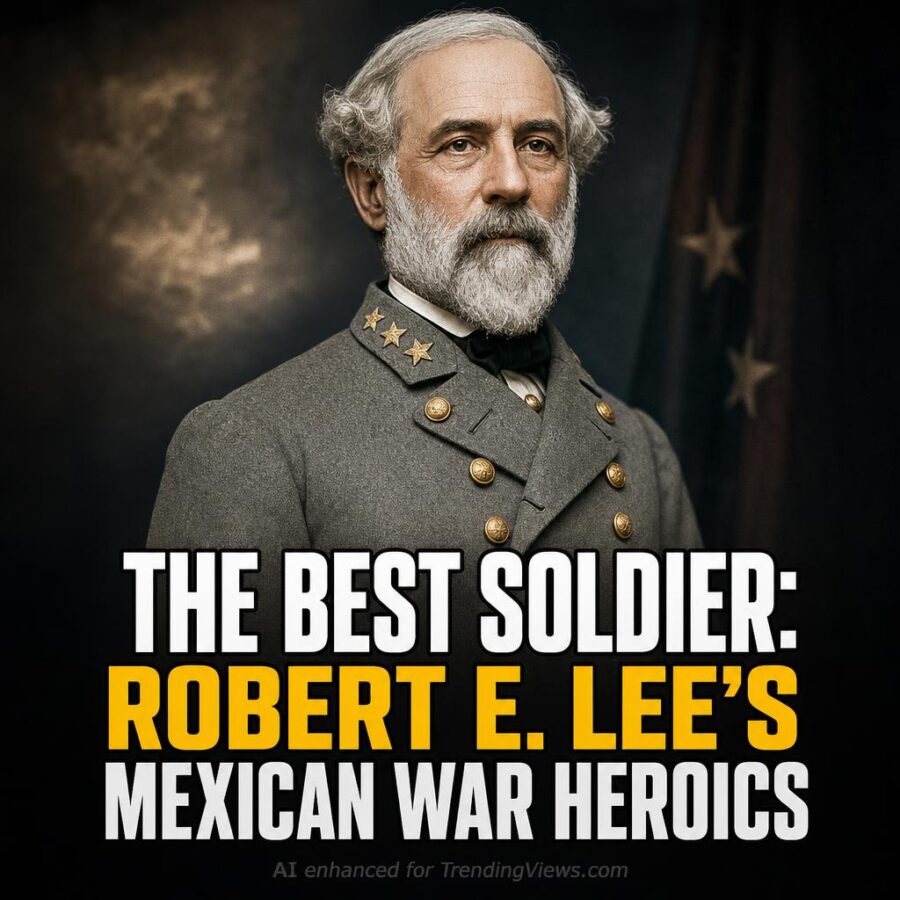
General Winfield Scott once called Robert E. Lee the best soldier he ever saw in the field.
That declaration did not come cheaply. Scott was one of the most accomplished military commanders in American history, and he made the statement after watching Lee perform across the entire arc of the Mexican-American War. What Lee did during that campaign stands as one of the most remarkable records of individual military achievement in U.S. history.
Lee served as a scout and engineer during Winfield Scott’s Veracruz campaign, where he identified precise battery positions and oversaw their construction. That work helped secure an American victory. From there, Lee went on to play a direct role in scouting and leading assaults at Cerro Gordo, Contreras, Churubusco, and Chapultepec, a string of engagements that formed the spine of the entire Mexico City campaign.
Special offer for our readers:
8 Top Credit Cards Offering Introductory No Interest into 2027
As originally reported, two specific episodes stand out among Lee’s feats in Mexico. At Cerro Gordo, he concealed himself beneath a log while Mexican soldiers rested nearby, waiting in silence to avoid detection during a critical scouting mission. The second episode was even more demanding. Lee crossed the Pedregal, a brutally dangerous stretch of volcanic rock, three separate times in a single night. That mission saved roughly 3,500 American troops. Scott called it “the greatest feat of physical and moral courage performed by any individual, to my knowledge, pending the campaign.”
Lee was not a young officer during any of this. He was middle-aged, operating under sustained physical strain, yet he did so with what observers described as indefatigable energy.
The significance of Mexico did not end when Lee came home. His Civil War generalship bears a direct imprint of what he learned in that earlier conflict. His willingness to divide forces and strike boldly traces back to lessons absorbed during Scott’s campaign. So does his reliance on skilled scouts and his comfort with improvised field fortifications. The Mexican War did not just test Lee. It shaped him.
Scott’s assessment was not a casual compliment. It was a professional judgment rendered by a man who had seen a great deal of war, and it reflected something measurable. Lee’s record in Mexico included precise engineering work under fire, reconnaissance deep inside enemy-held terrain, and repeated physical exertion across some of the most punishing ground in the theater.
Whether you view Lee through the lens of admiration or historical criticism, the Mexican War record demands attention. The facts of what he accomplished there are specific, documented, and striking. Scott saw all of it firsthand and chose his words deliberately. The best soldier he ever saw in the field. That is a verdict built on evidence.