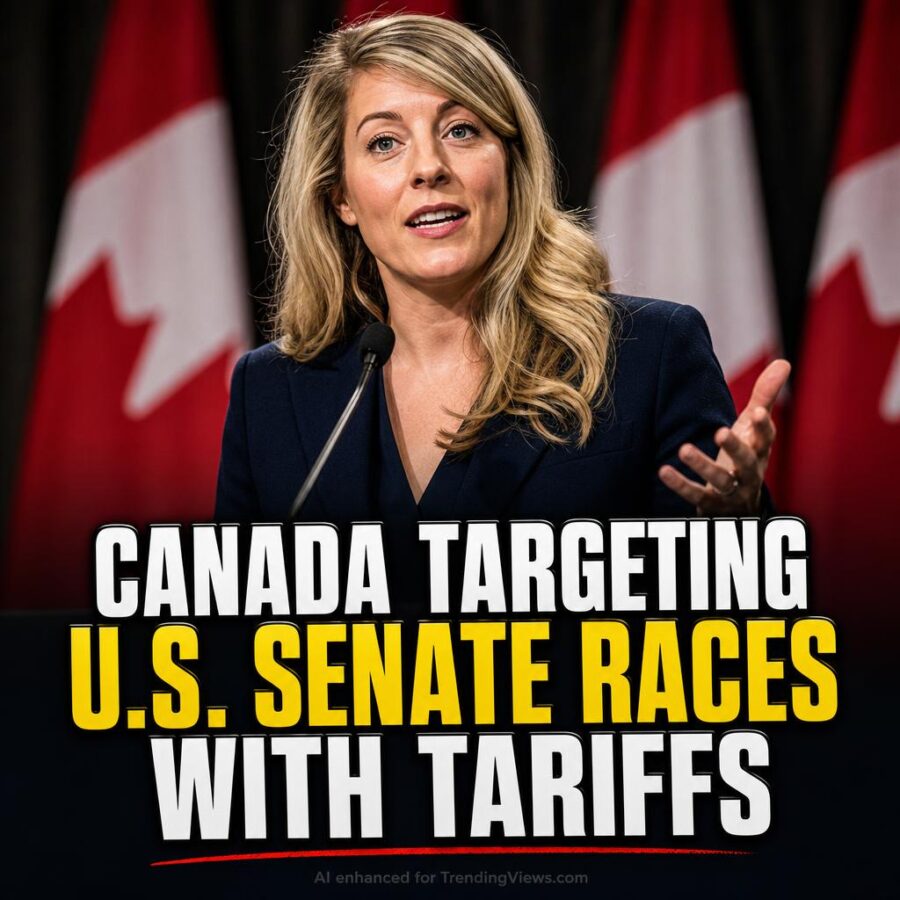
Canada’s own trade minister admitted the country’s new tariffs are designed to influence U.S. Senate elections.
That admission did not require a leak, a subpoena, or a years-long investigation. Industry Minister Mélanie Joly stated plainly that Ottawa’s tariff targets are meant to apply political pressure in specific midterm races. The goal, in her own framing, is to squeeze Republican candidates in states that will decide Senate control. That is not an interpretation. It came from the official who built the policy.
Trade experts read the tariff list and spotted the strategy immediately. Nearly 200 seafood tariff lines fall directly on Maine, where Republican Sen. Susan Collins is running for reelection in a race that could determine which party controls the chamber. Roughly half of all lobster caught in Maine ends up in Canada. As originally reported, a former U.S. trade official noted the obvious conclusion: targeting Maine seafood in an election year is not an accident. Collins had already flagged publicly that a trade dispute with Canada could hurt businesses in her state. Ottawa, it appears, found that vulnerability and chose to press it.
Special offer for our readers:
Tackle your credit card debt by paying 0% interest until 2027
The double standard is hard to miss. For years, “foreign election interference” was treated as an existential threat by Democratic leaders, their allies in the media, and a procession of congressional committees. Special counsels were appointed. Hearings ran for months. The phrase “attack on our democracy” became a fixture of cable news. All of that machinery was built around the premise that a foreign power trying to shape a U.S. election is intolerable.
Canada just announced it is doing exactly that, with a specific chamber and specific seats in mind. The reaction from those same voices has been silence.
To apply the argument fairly, there is a meaningful legal and moral difference between a government setting its own trade policy and a covert operation like hacking voter databases or running disinformation networks. Those distinctions matter and deserve acknowledgment. But Joly’s public statements eliminated most of the gray area. When a trade minister announces on the record that the point of the tariffs is to move specific American elections, the policy stops being ordinary trade strategy and starts functioning as an influence operation, one that simply uses customs forms instead of servers.
The test of any principle is whether it holds when the outcome changes. Foreign interference, the argument went, threatens the integrity of American democracy regardless of who wins or loses. Canada’s government has now stated a clear intent to tilt a Senate majority. The lawmakers and commentators who spent years sounding that alarm have gone quiet. The only thing that changed is which party stands to benefit from the outside pressure.
That silence is its own answer.