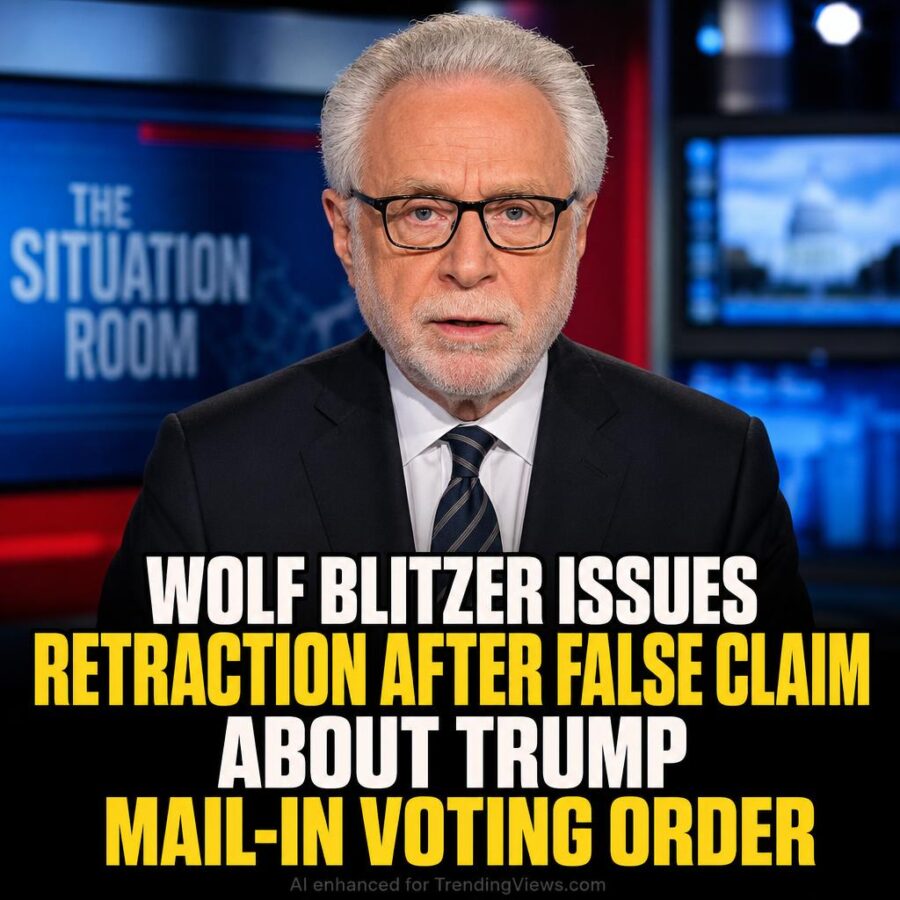
Wolf Blitzer issued a live on-air correction after CNN wrongly suggested military ballots would be harmed by a Trump order.
The correction came near the end of an episode of “The Situation Room,” where Blitzer had made comments implying that President Donald Trump’s executive order on mail-in voting would negatively affect ballots used by U.S. service members stationed abroad.
Blitzer addressed it directly before the show ended. “We discussed legal challenges to the Trump administration’s directives for the Postal Service on mail-in voting,” he said. “A comment I made suggested that U.S. military and overseas voters’ ballots would be impacted by these directives.”
Special offer for our readers:
Tackle your credit card debt with 0% intro APR into 2027
He then made the record clear. “I want to be clear right now: those ballots are exempt from the Postal Service’s new rules implementing the president’s March executive order. Those groups are covered under the Uniformed and Overseas Absentee Voting Act, just to be specific on that point.”
The original comments were made during an interview with Virginia Democratic Governor Abigail Spanberger. As originally reported, the conversation centered on a lawsuit Virginia and several other states filed to block the president’s order. A federal judge had already issued a 14-day temporary restraining order against the directive roughly a week before that suit was filed.
During the interview, Spanberger argued the Trump administration was trying to suppress voter participation. Blitzer then remarked that Virginia is home to many military personnel who depend entirely on mail-in ballots to cast their votes. Spanberger agreed, noting that service members, diplomatic staff, and intelligence personnel posted overseas all receive their ballots by mail at their various assignments around the world.
The executive order at the center of the dispute is titled “Ensuring Citizenship Verification and Integrity in Federal Elections.” Trump signed it on March 31, 2026. The order instructs the Department of Homeland Security and the Social Security Administration to compile state-by-state lists of confirmed U.S. citizens who will be 18 or older by the next federal election. It also directs the U.S. Postal Service to establish a set of rules governing how mail-in and absentee ballots are handled during federal elections.
Those rules include the creation of official election-mail envelopes with tracking barcodes. They also place strict limits on USPS delivery of ballots, restricting transmission to individuals whose names appear on state-submitted mail-in participation lists. States that want USPS to carry ballots would need to contact the agency and provide those lists directly.
The order also directs the attorney general to make election-related investigations and prosecutions a priority, specifically targeting those who tamper with mail-in ballots.
Critically, none of those provisions apply to ballots covered under the Uniformed and Overseas Citizens Absentee Voting Act, known as UOCAVA. That federal law requires states to provide absentee voting procedures for active military members, their eligible family members, and U.S. citizens living outside the country. Congressional research confirmed that military and overseas ballots under UOCAVA fall entirely outside the scope of the new rules.