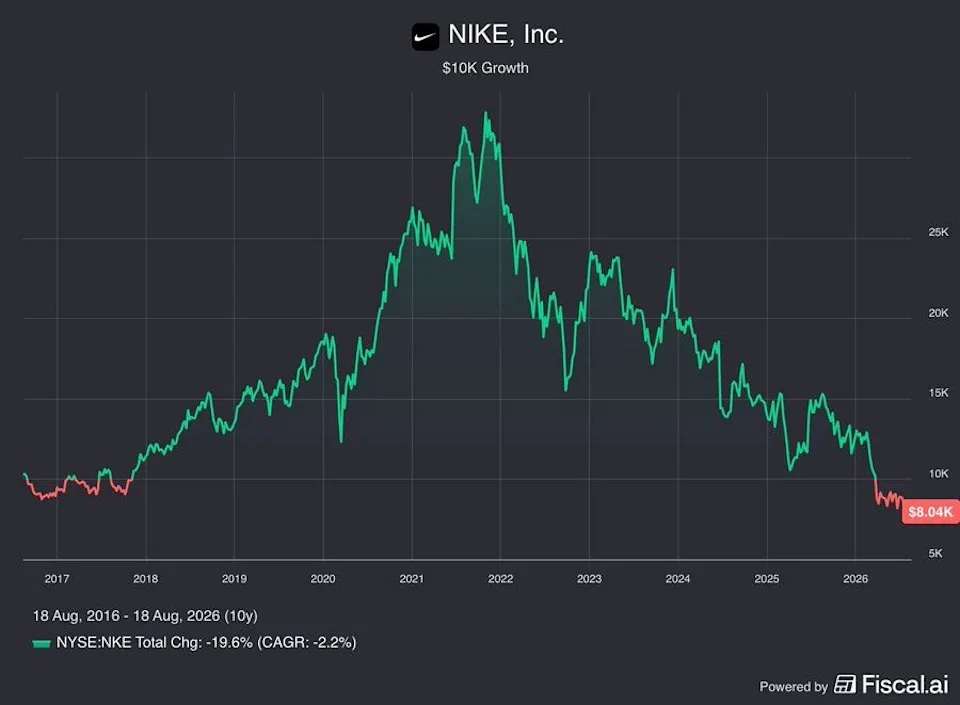
Nike ($NKE) will be officially removed from the prestigious S&P 100 index before the market opens on Monday, September 21, 2026. Announced by S&P Dow Jones Indices during its quarterly rebalance, the decision follows a multi-year market downturn for the sportswear giant.
While Nike will retain its position in the broader S&P 500, its exclusion from the mega-cap index marks a major symbolic and financial shift.The removal caps off a bruising period where Nike’s stock plummeted roughly 78% to 80% from its 2021 record high, wiping out more than $220 billion in market value.
The company recently touched a 12-year price floor in the high-$38 to $39 range. Analysts attribute the decline to a flawed Direct-to-Consumer (DTC) strategy that alienated wholesale partners, a lack of fresh product innovation, and sharp revenue contractions in vital global markets like Greater China.
Special offer for our readers:
Tackle your credit card debt with 0% intro APR into 2027
As part of the index reshuffle, rising tech and infrastructure firms like Palo Alto Networks ($PANW) and Dell Technologies ($DELL) will replace legacy giants, including Nike, Honeywell, and Colgate-Palmolive.For investors, this deletion triggers mechanical selling pressure. Because massive institutional funds and ETFs track the S&P 100, fund managers will be forced to liquidate estimated hundreds of millions of dollars in Nike shares before the deadline.
While index removals are typically lagging indicators that reflect damage already done, the move highlights the steep hill Nike faces. Under new leadership, management does not project a meaningful structural turnaround until 2027 at the earliest, reinforcing the risks of holding concentrated positions in struggling consumer cyclicals without proper portfolio diversification.
It doesn’t help that Nike has underperformed the S&P 500 by the widest margin in about 25 years. Where did Nike go wrong?