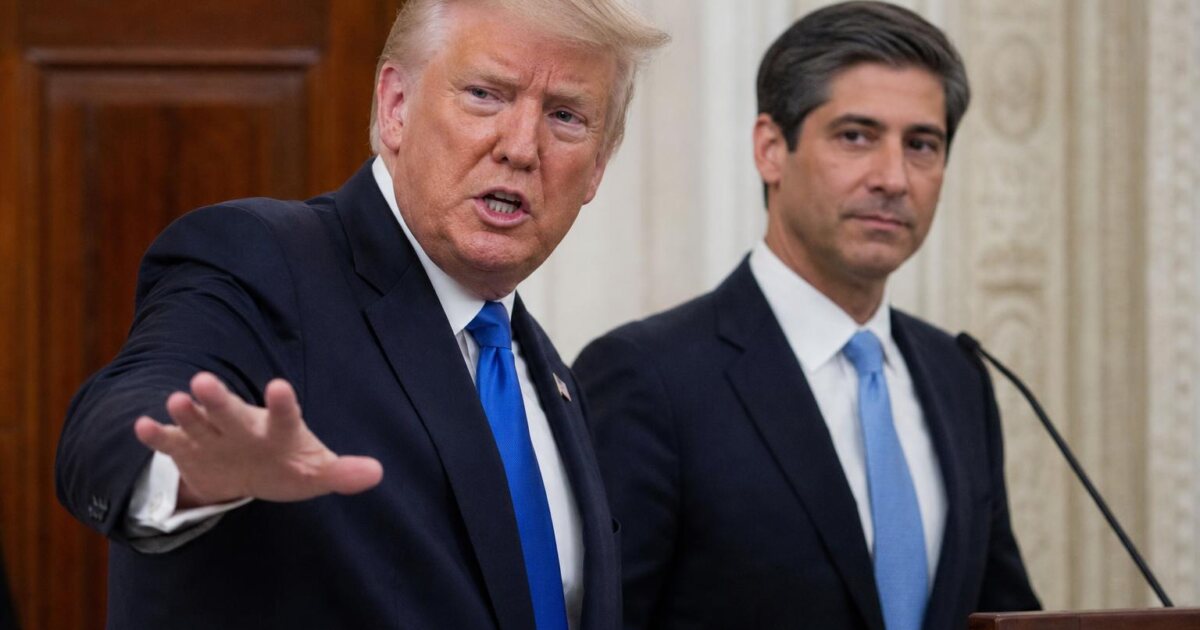
A nuclear-powered spacecraft bound for Mars will launch in 2028, Trump announced Friday.
The president made the announcement during a visit to NASA’s Johnson Space Center in Houston, Texas. He also signed an executive order to create a U.S. Space Academy and presented the Congressional Space Medal of Honor to the four-member crew of the Artemis II mission, which completed a lunar orbital flight this past April.
The Artemis II crew included Commander Reid Wiseman, Pilot Victor Glover, Mission Specialist Christina Koch, and Canadian Space Agency Mission Specialist Jeremy Hansen. Trump praised both the astronauts and the broader NASA team behind the mission. “These astronauts did not do it alone,” he said. “I want to salute all of the engineers and scientists, launch and landing specialists, everyone at NASA who helped make this mission a great success.”
Special offer for our readers:
Tackle your credit card debt with 0% intro APR into 2027
On the Mars mission, Trump said NASA is developing the first nuclear-powered interplanetary spacecraft. “They have to go nuclear because they have essentially unlimited fuel,” he explained. “This ship will be among the first of what will ultimately be a massive American starfleet.”
As originally reported, the spacecraft in question is Space Reactor-1 Freedom, a planned NASA technology demonstration using nuclear electric propulsion. Scheduled for launch in late 2028, it would travel to Mars, conduct flybys, and deploy the SkyFall payload, which consists of three helicopters modeled on the Ingenuity design. Those helicopters would collect scientific data and survey potential landing sites. The mission is designed to prove out fission power and propulsion technology for future exploration.
Trump framed the broader effort in sweeping terms. “From the very beginning, America has always been a frontier nation and space is the highest of all the frontiers,” he said. “A nation cannot be first on Earth if we’re going to be second in space.” He added that plans include stopping at the Moon before pushing on to Mars.
The executive order Trump signed establishes a Presidential Commission on the United States Space Academy, chaired by NASA Administrator Jared Isaacman. The commission has 120 days to deliver recommendations covering governance, curriculum, location, service obligations, and implementation. The proposed academy would blend technical education with leadership training for careers spanning military, civil, and commercial space sectors.
Isaacman called the academy a “big deal” and described it as a transformational step toward building the workforce needed for lunar surface missions, a Moon base, orbital commerce, and future science missions.
The administration also referenced a National Security Presidential Memorandum signed on August 20, directing efforts to enable more than 1,000 launches and reentries on American soil each year by 2030. That memorandum instructs NASA to support commercial transportation to the Moon and Mars, including exploring commercial options for crewed Mars missions. A crewed lunar landing is targeted for 2028, with initial lunar outpost elements planned by 2030.