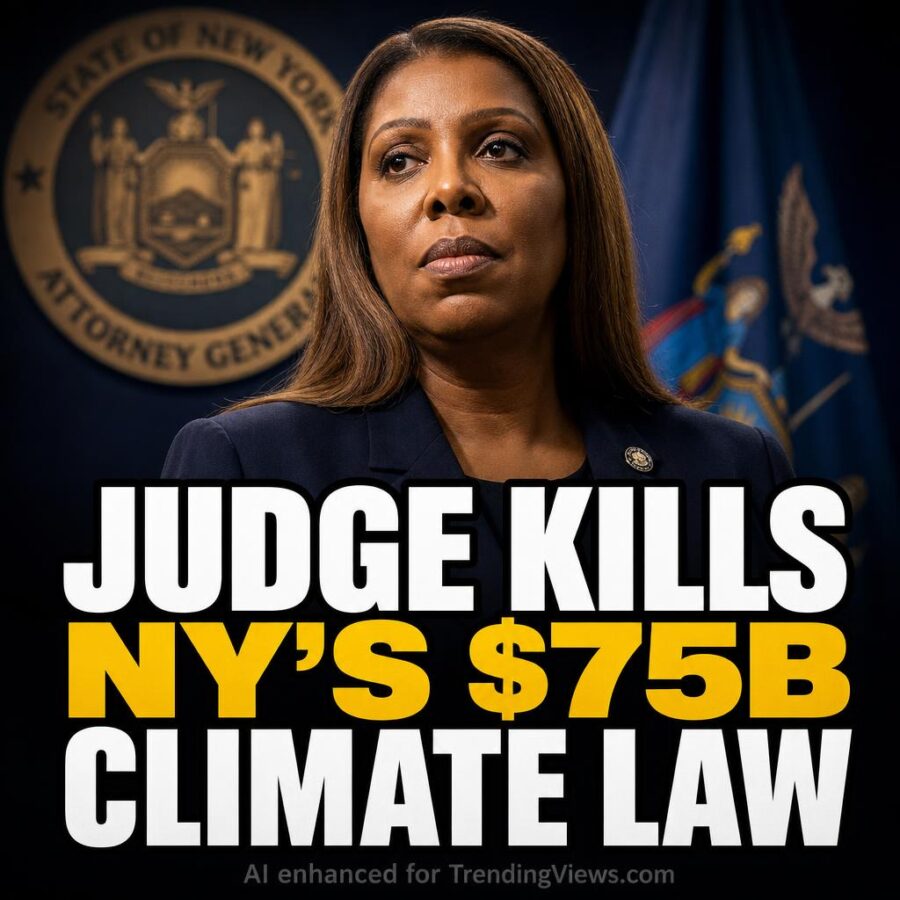
A federal judge has blocked New York’s $75 billion climate superfund law, handing Letitia James a significant legal defeat.
Chief U.S. District Judge Brenda Sannes ruled Monday that New York cannot compel energy companies to pay for greenhouse gas emissions produced worldwide under the state’s Climate Change Superfund Act. The ruling granted summary judgment to the challengers, a coalition of Republican-led states and energy industry groups who argued the law far exceeded New York’s legal reach.
The decision shuts down one of the most aggressive attempts by any state to extract payments from fossil fuel producers under the banner of climate policy.
Special offer for our readers:
Hands Down Some Of The Best Credit Cards For 2026
According to a report, the case, State of West Virginia v. James, was brought by 22 states and four industry groups. James was named as a defendant in her official capacity, along with officials from the New York State Department of Environmental Conservation and the Department of Taxation and Finance.
The challengers made a straightforward argument. New York, they said, was attempting to build its own liability framework covering emissions generated across the entire country and around the globe. Sannes agreed.
She concluded that the federal Clean Air Act bars New York from imposing liability on greenhouse gas emissions that originate outside state lines. The ruling also rejected New York’s argument that its law should hold up regardless of which legal standard the court applied.
The defeat is a notable blow to James, who has positioned climate accountability as a central part of her tenure as attorney general. The blocked law represented one of the state’s most expansive efforts to hold fossil fuel companies financially responsible for climate-related damages.
With federal preemption now cited as the deciding factor, New York’s path forward on the superfund approach appears narrow. Sannes found the state’s legal framework fundamentally incompatible with existing federal law, leaving little room for the measure to survive in its current form.