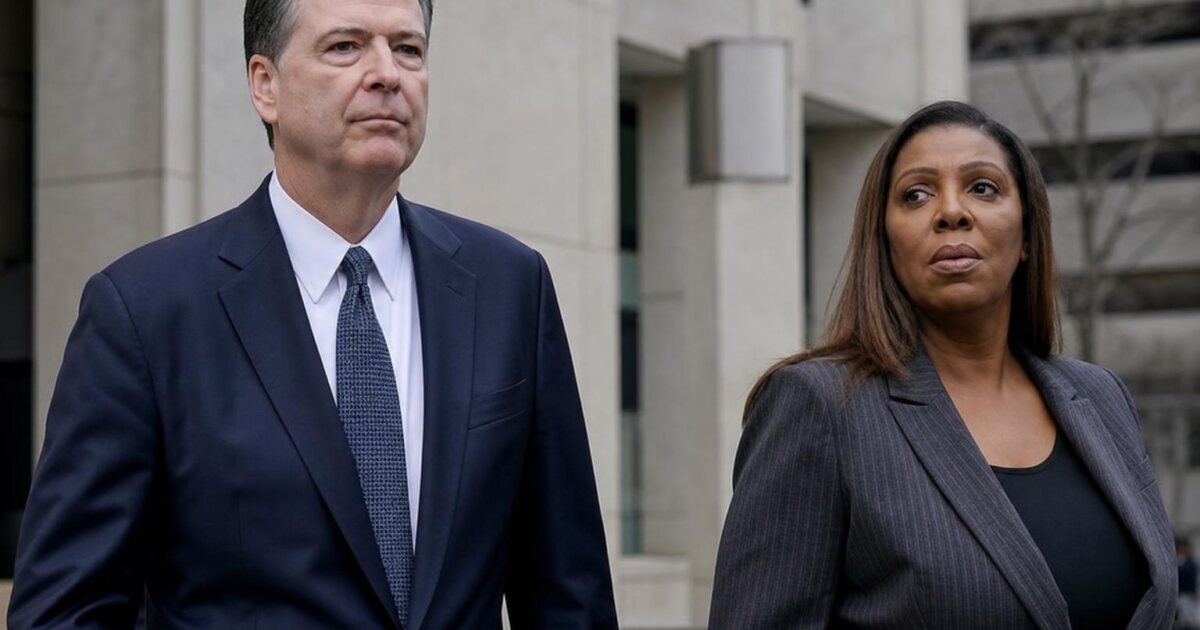
A federal appeals court openly questioned the Justice Department’s case on Tuesday, signaling deep skepticism toward its push to revive criminal prosecutions against James Comey and Letitia James.
The proceedings before the Richmond-based 4th U.S. Circuit Court of Appeals centered on a narrow but consequential legal question: whether former Attorney General Pam Bondi had the authority to appoint a prosecutor named Lindsey Halligan as interim U.S. attorney for the Eastern District of Virginia after another interim U.S. attorney had already served in that role.
How the Cases Were Dismissed
Halligan personally obtained the grand jury indictments against both Comey and James. A federal district judge later ruled that her appointment was unlawful and dismissed both cases. The ruling rested on the conclusion that Bondi lacked statutory authority to install another interim U.S. attorney after Erik Siebert had already served a 120-day term in the position, departing in September 2025.
Special offer for our readers:
Tackle your credit card debt by paying 0% interest until 2027
U.S. District Judge Cameron McGowan Currie found the appointment violated the federal law governing temporary U.S. attorney placements. Because Halligan was the one who brought the indictments, Currie threw out the charges entirely. The Justice Department is now asking the 4th Circuit to reverse that ruling, arguing the lower court read the appointment statute too narrowly.
Two of the three judges on the panel were openly skeptical of that argument. Chief Judge Albert Diaz questioned whether the government’s position could allow the Justice Department to make an endless series of interim appointments, indefinitely bypassing Senate confirmation. DOJ attorney Henry Whitaker acknowledged that successive temporary appointments would technically be permitted under the government’s reading of the law, though he argued that relying on interim prosecutors for long periods would make little practical sense. You can follow the Comey and James appeals case as the 4th Circuit weighs its decision.
What Comey and James Were Charged With
Comey faced charges of making false statements to Congress, tied to allegations that he authorized leaks to the media. He denied any wrongdoing. James was charged with bank fraud, stemming from claims she misrepresented her intended use of a Virginia property. She also denied the allegations.
Both defendants have argued the prosecutions were acts of political retaliation. President Donald Trump fired Comey as FBI director in 2017 during an active federal investigation into possible ties between his 2016 campaign and Russia. James later filed a civil fraud lawsuit against Trump and his business in New York. The criminal cases against both were brought after Trump publicly called on Bondi in September 2025 to pursue action against them and other political adversaries. The Justice Department has maintained the prosecutions were legitimate.
What Comes Next for Both Cases
The 4th Circuit did not issue a ruling Tuesday. Its eventual decision will determine whether the dismissed charges against Comey and James can be reinstated or whether the lower court’s ruling stands.
Comey also faces a separate federal prosecution connected to a social media post depicting seashells arranged as the numbers “86 47,” which authorities alleged constituted a threat against Trump. That case remains active and was not part of Tuesday’s arguments.