
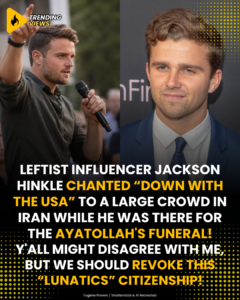
A video circulating on social media claims that American political commentator Jackson Hinkle led anti-United States chants before a large crowd in Tehran, Iran, during official funeral events. The clip has drawn calls from some conservative accounts to strip Hinkle of his U.S. citizenship. This is a guide to what is actually established, what is disputed, and what U.S. law says about revoking citizenship.
What happened
Hinkle is a U.S.-based online commentator with a large following on X (formerly Twitter). He is known for provocative statements and has often defended Iran, Russia, and the Palestinian cause. He describes his own politics as “MAGA communist,” a self-coined label; critics have called him both far-left and far-right, and his ideology is genuinely contested.
The current claim is that he traveled to Iran and joined crowds chanting slogans against the United States during funeral proceedings. Several details in the version spreading online are unverified or unclear. Notably, Ayatollah Ali Khamenei, Iran’s Supreme Leader, is alive, so any reference to “the Ayatollah’s funeral” cannot describe a funeral for him. Large state funerals in Iran have been held for other senior figures. Which event a given clip shows, and exactly what was chanted, are points that independent confirmation has not fully settled.

What can be said plainly: the accusation is being repeated widely, the surrounding commentary is heated, and some specifics attached to it are either wrong or unconfirmed.
Why it matters
The controversy has become a flashpoint because it mixes three separate questions that are easy to blur together:
- Fact: whether Hinkle actually chanted anti-U.S. slogans, and where and when.
- Judgment: whether an American publicly siding with a hostile government abroad is acceptable, offensive, or dangerous.
- Law: whether the U.S. government could remove his citizenship over it.
Those are different things. A person can be widely condemned for an act that is nonetheless legally protected speech.
Can the U.S. actually revoke citizenship?
This is where the loudest demands run into the narrowest legal reality. U.S. citizenship is very hard to remove, and the rules depend on how a person became a citizen.
- Natural-born citizens — people who are citizens from birth — cannot simply have citizenship taken away by the government as punishment. The Supreme Court ruled in Afroyim v. Rusk (1967) that citizenship cannot be stripped without a person’s own voluntary intent to give it up.
- Loss requires intent. Certain acts, such as formally serving in a foreign army or taking foreign office, can lead to loss of citizenship, but only if done with the specific intention of abandoning U.S. nationality. Chanting at a rally does not automatically meet that bar.
- Denaturalization — undoing citizenship — applies only to naturalized citizens, and only when the government proves they obtained it through fraud or lied during the process. It is not a general penalty for unpopular political speech.
Treason under U.S. law is also narrowly defined: levying war against the United States, or giving “aid and comfort” to enemies, and it requires either a confession in open court or two witnesses to the same overt act. Political speech, even speech many find offensive, rarely fits that definition.
Whether Hinkle is a natural-born or naturalized citizen has not been publicly established in this dispute, but under current law neither path makes revocation over a chant straightforward.
The practical takeaway
Treat the viral version cautiously. The core accusation is being repeated faster than it is being verified, and some attached details are inaccurate. Separate the moral reaction from the legal claim: even if the video is exactly as described, stripping a U.S. citizen of nationality for political speech faces steep constitutional and statutory barriers. The demand and the law are not the same thing.