
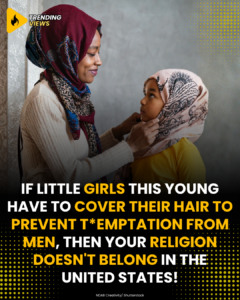
A widely shared social media claim argues that Muslim families who have young girls wear a hijab do not belong in the United States. The claim ties together several separate topics: religious dress, child welfare, immigration, and constitutional law. This article separates what is a matter of fact from what is a matter of opinion.
A hijab is a headscarf worn by some Muslim women and girls. Practices vary widely. Some families have girls begin wearing one around puberty; others never require it; some adults choose it in adulthood. There is no single rule that all Muslims follow.
What the claim says
The core argument in the viral post makes three assertions rolled into one:

- That covering a young girl’s hair is done to “prevent temptation from men.”
- That this practice is incompatible with American values of freedom and equality.
- That immigration policy should be used to exclude people who hold such beliefs.
The first point is an interpretation, not a settled fact. Muslim scholars and families give many reasons for modest dress, including religious observance, cultural identity, and family tradition. Attributing it solely to controlling men’s behavior reflects one viewpoint, not a documented universal motive.
What US law actually protects
The First Amendment protects religious practice, including how people dress. This is established law, not opinion. Key points:
- Religious freedom is broad. The government generally cannot ban religious clothing or single out one faith for exclusion.
- Parents have wide authority. Courts give parents significant latitude over how they raise children, including religious upbringing, within limits set by child-welfare law.
- Coercion and abuse are already illegal. Forcing, harming, or neglecting a child is a crime regardless of religion. Existing law covers those situations without targeting any faith.
So the question of whether a family “belongs” in the country is not one that current US law answers by religion. The Constitution bars the government from favoring or disfavoring a religion.
Where immigration fits in
Immigration law does allow the government to screen applicants and to bar people on specific grounds, such as security threats or criminal history. That is a factual part of how vetting works.
What the law does not do is exclude people simply for holding a particular religious belief. A blanket policy targeting a faith would face immediate constitutional challenge. The 2017 travel restrictions that critics called a “Muslim ban” were litigated for years before a narrowed version was upheld, and the courts focused on national-security justifications, not religion itself.
Fact versus opinion
To keep the pieces clear:
- Fact: Some Muslim families have girls wear a hijab; practices differ widely.
- Fact: US law protects religious dress and bars religion-based exclusion.
- Fact: Child coercion and abuse are already illegal for everyone.
- Opinion: That the practice is inherently oppressive.
- Opinion: That immigration policy should screen out a religion.
The viral post presents opinions as if they were legal conclusions. They are not.
The practical takeaway
If you see this claim, the single thing to remember is that it blends a genuine legal topic with a contested value judgment. US law already prohibits harming children and already protects religious dress. Whether a specific practice in a specific family is coercive is a child-welfare question answered case by case, not by a religion’s name. There is no US legal mechanism that removes people or bars entry for belonging to a faith, and any attempt to create one would be tested against the Constitution.