
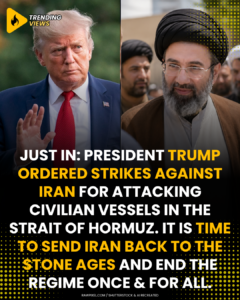
A post spreading on social media claims that President Donald Trump ordered military strikes against Iran in response to attacks on civilian vessels in the Strait of Hormuz. The post frames the alleged strikes as a decisive move and calls for ending Iran’s government. The claim is being shared widely, but it comes from a partisan social media page, and the accompanying image is labeled as AI-recreated. As of this writing, there is no independent confirmation from official sources that such an order was given.
Here is what the claim contains, what is verifiable, and what remains unconfirmed.
What the post claims
The post makes several assertions at once:

- That Trump ordered strikes against Iranian targets.
- That Iran attacked civilian ships in the Strait of Hormuz — the narrow waterway between Iran and Oman that connects the Persian Gulf to the open ocean.
- That the strikes were a response to those attacks.
The post then adds opinion and calls to action, urging support for the military and the removal of Iran’s government. Those are argument and advocacy, not reporting. The core factual claim — that an order was given — is what a reader should focus on, and it is the part that is not backed by any cited evidence.
What is actually confirmed
Nothing in the post can be verified from the post itself. It cites no official statement, no named official, and no news agency. The image credit notes the picture was “AI recreated,” meaning it is not a photograph of a real event. That alone is a signal to treat the claim with caution.
To be clear about the categories of information here:
- Established fact: The Strait of Hormuz is a real and strategically critical waterway. Roughly a fifth of the world’s oil passes through it. Incidents involving ships there have occurred in past years and have raised tensions.
- Unconfirmed claim: That Trump ordered strikes, and that Iran attacked civilian vessels in a specific recent incident. The post provides no source for either.
- Opinion: The calls to “end the regime” and the political blame assigned to past administrations. These are viewpoints, not events.
Why the Strait of Hormuz matters
The strait is one of the most important choke points in global trade. At its narrowest, it is about 21 miles wide. Because so much oil and gas moves through it, any threat to shipping there can move energy prices and draw military attention from many countries, not just the United States and Iran.
This is why claims about conflict in the strait spread quickly. The stakes are high, the topic is emotionally charged, and readers may share alarming headlines before checking whether they are true.
How to judge a claim like this
When a dramatic geopolitical claim appears in your feed, a few steps help you separate fact from rumor:
- Check whether major news organizations are reporting the same event. A real strike would be covered widely and quickly.
- Look for an official source — a government statement, a named spokesperson, or a defense agency.
- Read the image credit. Labels like “AI recreated” mean the picture is not evidence.
- Separate the factual claim from the opinion attached to it. Advocacy language is designed to prompt sharing, not to inform.
The practical takeaway
Treat this post as an unverified claim, not confirmed news. The Strait of Hormuz is genuinely important, and tensions between the United States and Iran are a real and recurring subject. But the specific assertion that strikes were ordered is not supported by any evidence in the post, and the image is artificial. Before sharing, wait for confirmation from established news outlets or official statements. If those sources do not report it, the claim has not been verified.