
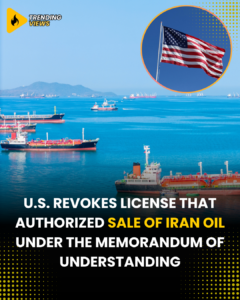
The United States has revoked the license that temporarily authorized Iran to sell oil under a memorandum of understanding, restoring tighter restrictions on Iranian oil exports.
The move accompanied a new round of U.S. airstrikes targeting Iranian military assets, according to statements attributed to U.S. officials and U.S. Central Command.
U.S. Central Command said the strikes followed accusations that Iran attacked multiple commercial vessels in the Strait of Hormuz, one of the world’s most heavily used shipping routes.

Central Command described the operation as intended to impose significant costs on Iran and characterized the alleged attacks on civilian maritime traffic as a violation of a recent ceasefire understanding.
U.S. officials said Iran’s latest actions made continued sanctions relief unjustifiable, prompting the revocation of the license that had permitted limited oil sales.
Sanctions relief withdrawn
The revoked license had allowed Iran to sell oil temporarily under a previous memorandum of understanding between the two governments.
Ending the authorization effectively reinstates broader limits on Iranian crude exports, according to U.S. officials cited in the account.
The measure targets a central component of Iran’s economy. Oil revenue has long been a primary source of state income, and export restrictions have been a recurring instrument of U.S. pressure on Tehran.
Strait of Hormuz
The Strait of Hormuz connects the Persian Gulf to the Gulf of Oman and the Arabian Sea. It carries a significant share of the world’s seaborne oil shipments.
Disruptions to traffic through the waterway can affect global energy supplies because a large volume of crude and liquefied natural gas passes through the channel.
The alleged attacks on commercial vessels, as described by Central Command, prompted the military response and heightened attention on the security of the route.
Market reaction
Oil prices moved higher as investors weighed the risk of supply disruptions through the strait, according to the account of the developments.
The price movement reflected concern over potential interruptions to shipments passing through the waterway.
Rising tensions
The combined steps have increased tensions between the United States and Iran, raising concerns about regional stability and global energy markets.
The account did not include a response from Iranian officials to the strikes or the revocation of the oil license.
It also did not specify the number of vessels said to have been targeted, the locations of the airstrikes, or the timing of the ceasefire understanding referenced by U.S. Central Command.