
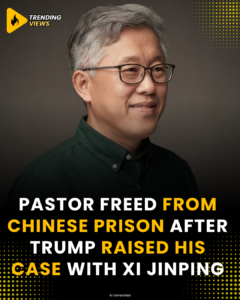
The arrival gate at Los Angeles came with a name attached to it on Friday: Ezra Jin, the pastor of one of China’s best-known underground churches, stepping onto American soil after months held by Chinese authorities. He had last been a free man in October, when the crackdown began. Now he was reunited with his family. The prison walls that had held him were an ocean away.
Jin, also known as Jin Mingri, founded Zion Church, a prominent unregistered house church that operated outside the bounds of China’s state-sanctioned religious system. He was one of nearly 30 Zion Church pastors and staff members detained in October, swept up in what human rights advocates described as one of China’s largest crackdowns on evangelical churches in decades. The arrests targeted leaders and members of a congregation that had refused to register with the government.
According to statements from his family and the Christian human rights organization tracking his case, Chinese authorities told Jin he was being released as a result of negotiations between President Donald Trump and Chinese leader Xi Jinping. His freedom, in other words, arrived through diplomacy conducted at the highest levels of two governments.

The appeal, advocates say, was made directly. Trump raised Jin’s case with Xi during a state visit to Beijing, and the release followed. For a pastor whose ministry had placed him squarely in the path of a state that tolerates religion only on its own terms, the intervention proved decisive.
A Church Outside the System
Zion Church built its reputation as an underground congregation, meaning it worshipped without the official sanction that China requires of religious institutions. Unregistered house churches occupy a precarious space in the country. They gather, they grow, and they operate under the constant possibility that authorities will decide to act.
In October, authorities acted. The coordinated detention of pastors and staff signaled the scale of the operation, and it left one of the country’s more visible evangelical communities without its leadership. Jin, as founder, was among those taken.
The Road to Los Angeles
The months between his detention and his release were shaped by advocacy from human rights groups and, ultimately, by the diplomatic channel that opened between Washington and Beijing. When the decision to release him came, it came with an explanation: the negotiations between the two heads of state.
Jin arrived in Los Angeles on Friday, where his family was waiting. The reunion closed a chapter that had begun with a knock and a detention order half a world away.
His case sits at an intersection that few stories reach — the fate of a single pastor bound up in the relationship between two of the world’s most powerful governments. For the members of Zion Church, and for the advocates who pressed his cause, the outcome offered something concrete after months of uncertainty. A man who had been held was now free.
The gate at Los Angeles is an ordinary place, the kind of arrivals point that thousands pass through without notice. On Friday it held Ezra Jin, home at last, the ocean behind him and his family in front of him.