
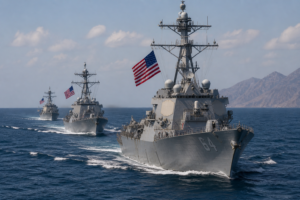
The United States military has taken decisive action by sinking six Iranian small boats near the Strait of Hormuz, intensifying tensions in this crucial maritime corridor. This operation occurred amidst a fragile ceasefire between the U.S. and Iran.
Details of the Military Engagement
U.S. Central Command (CENTCOM) has confirmed the details of the engagement, which they described as a defensive measure aimed at safeguarding commercial vessels navigating through the narrow waterway. This operation is part of President Donald Trump’s recently launched initiative, known as “Project Freedom.” CENTCOM Commander Admiral Brad Cooper stated that the Iranian boats formed a smaller-than-normal contingent, approaching shipping traffic in a manner deemed threatening.
According to Admiral Cooper, the Iranian vessels involved in this incident numbered just six. Historically, incidents in the Strait have seen Iran deploy between 20 to 40 small boats for similar harassment operations. The U.S. response was described as both swift and overwhelming.
Military Capabilities Utilized
To neutralize the Iranian boats before they could pose any risk to commercial shipping, U.S. forces employed AH-64 Apache attack helicopters and MH-60 Seahawk helicopters. Admiral Cooper emphasized the high level of military capability and firepower present in and around the Strait, reinforcing that U.S. forces are prepared to respond immediately to any perceived threats in the region.

Context of Regional Tensions
This confrontation occurs at a time when the Trump administration is actively seeking to reopen the Strait of Hormuz, which has been effectively constrained by Iranian actions since the onset of conflict earlier this year. U.S. naval forces are currently guiding commercial ships through the area as part of the broader efforts to secure maritime traffic, supported by a substantial military presence.
During an interview, President Trump reiterated a hardline approach, cautioning Iran against targeting U.S. assets. He stated that should Iran attack American vessels, they would face severe consequences. Additionally, he characterized Iran as appearing “much more malleable” in ongoing peace discussions, despite the continued tensions.
Recent Developments and Threats
Recent maritime incidents have heightened concerns regarding security in the region. On the day prior to the military engagement, the British military’s maritime trade authority reported that a commercial vessel had been attacked by several small craft approximately 11 miles off the coast of Iran. Although details regarding this incident remain sparse, it underscores the persistent threats faced by vessels operating in the area.
In response, Iranian officials have issued repeated warnings that any military presence in the Strait, whether U.S. or foreign, would be perceived as hostile. They have vowed to target forces seen as infringing upon their territorial waters, complicating efforts aimed at stabilizing the situation.
Maritime Traffic and Economic Implications
Despite the threats from Iran, U.S. officials remain committed to securing maritime operations in the region. CENTCOM has reported that at least 49 ships have already been redirected as part of the broader initiative to maintain the flow of global commerce through this critical waterway.
The economic implications of this situation are considerable, as the Strait of Hormuz is a vital route for a significant portion of the world’s oil supply. Any disruptions to shipping traffic can have immediate and widespread repercussions across global markets. Oil prices have already exhibited volatility in light of these renewed tensions, with investors closely monitoring the developments for signs of further escalation.
Currently, peace talks between the United States and Iran appear stagnant, with President Trump criticizing Tehran’s recent proposals as inadequate. Although diplomatic avenues remain accessible, the tensions on the water illustrate the increasingly complicated dynamics in the region.